You Should Read BUCKEYE by Patrick Ryan

Reading Notes
I feel a bit redundant recommending a book with the lucky “Read with Jenna” icon on its cover, but in case you are not yet in the choir to which I am preaching: You should read Buckeyeby Patrick Ryan. (And if you’re in the choir, sing along! I know you know the chorus.)
I’ve recommended this book to many people over the last couple of weeks, and each time I’ve been asked, “What’s it about?” It’s a fair question, especially before embarking on a 448-page book, but I couldn’t answer it. I’d respond with something uninspired, like this: “It’s about two families during WWII, but also into the Vietnam War, and it’s really good.” Or this: “One guy has a short leg and marries a girl who holds seances, and this other woman likes to dance and marries a WWII sailor, and they all live in Ohio.”
Oof. It’s shocking I convinced even one friend to read this book with such a poor pitch! None of these details give any hint of the magic in this particular story.
What I realized, after so many failed explanations, is that I enjoyed Buckeye because it resists the simple distillation of a pitch. I’m no publishing expert, but many, many contemporary books I’ve read hinge on a catchy, hooky premise, with widely varying levels of execution. (If you’re querying agents, this premise is the dreaded but necessary logline.)
An octopus helps a woman discover the truth about her son’s disappearance. (Remarkably Bright Creatures by Shelby Van Pelt)
Everyone in the world receives a box, and inside that box is a string that foretells the time left in each person’s life. (The Measureby Nikki Erlick)
A car full of recently introduced half-siblings drive across the country to confront their father. (Run for the Hills by Kevin Wilson)
But I wanted to foist Buckeye upon everyone I talked to because it doesn’t rely on a gimmicky question or set of circumstances. Ryan prioritizes his characters’ inner worlds over “gotcha” plot twists, and the result is a satisfying family saga.
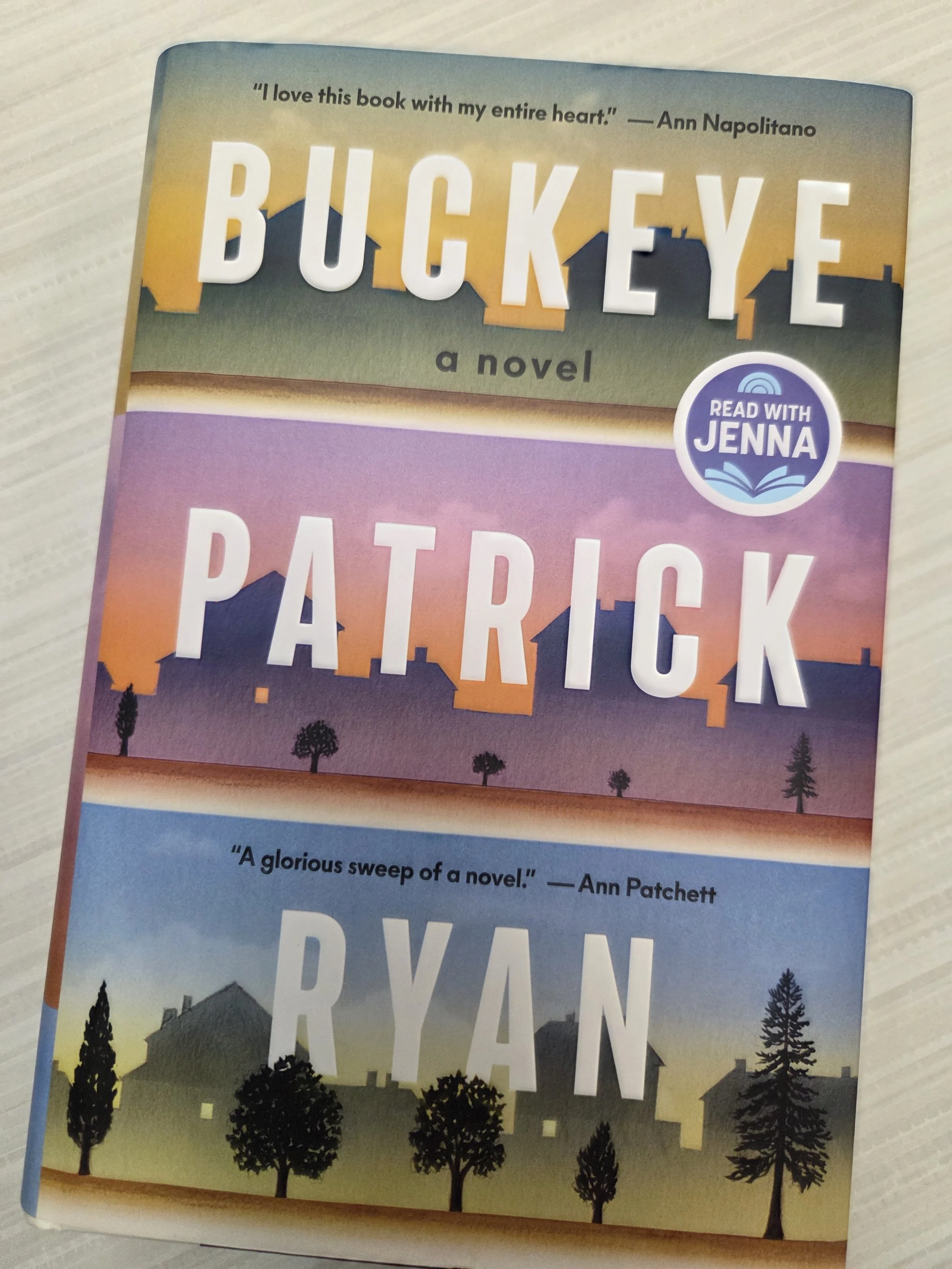
Cal Jenkins, born with one leg shorter than the other, has felt inferior for much of his life. When he’s not allowed to enlist after Pearl Harbor, he resigns himself to small-town life in Bonhomie, Ohio. A romance with Becky brightens his life, and after their marriage, Cal works in her father’s hardware store. But their relationship suffers when Becky holds seances in their home and helps neighbors speak with lost loved ones; Cal doesn’t believe in her abilities.
Meanwhile, a young woman named Margaret grows up between foster homes and an orphanage. When she meets a handsome man named Felix, she gladly accepts his proposal and follows him to Bonhomie, where she finds she doesn’t fit the mold of a suburban housewife very well.
Buckeye follows the intertwined fates of these two families as they make their way through a tumultuous three decades in America, and that is all I’m going to tell you because there’s nothing like a summary to spoil the joy of an immersive world. Reading this novel reminded me of reading Little Women when I was ten, completely engrossed in the March family’s drama and unwilling to say goodbye to the characters when the book ended.
Here I am, so unable to say goodbye to Cal and Becky and Margaret and Felix that I’m imploring you to read Buckeye, too.
Need-to-Know
Pub Date: 2025
Length: 448 pages; audiobook runs about 16 hours
Setting: Ohio
Timeline: primarily 1940s - 1970s
Narrator: third-person omniscient
Pairs Well With: Forest Gump; music of Duke Ellington; swing dancing; ferris wheels
Book Club
Ryan writes, “The early 1950s was a good time to be ambitious and privileged in America. Business boomed big for big businesses already booming, and it boomed medium for smaller businesses hoping to boom, and for those who knew no boom at all and had no chance of experiencing one, well, that’s what the American Dream was for” (239). To what extent do you think the characters were “ambitious and privileged”? How did they view the American Dream?
Letters are an important motif throughout the book. Cal’s father frequently writes to the US President, Margaret writes a life-changing note for Felix, and Becky writes a letter to her adult self. When was the last time you handwrote a letter? Who was it to, and what did you say? If you were to write a letter today, what would you write to the President? To your partner or spouse? To yourself?
Close Reading
When a reporter visits Becky to learn about her special talent, she poses a tough question: “How accurate would you say your communications with the spirits are?” Becky is not quite sure how to respond. Ryan writes:
“Becky thought about that for a moment. The question was flawed, she said. Then explained: it was like this sofa they were sitting on. Was it real? It felt real to her. But could she say it was accurate? Not without knowing every sofa, from every angle. Her rule for herself, she said, was that she would only relay to another person what was discernible and felt genuine. Sometimes, that was a voice. A word or two, a phrase, a whole sentence that arrived only after intense concentration that often left her with a headache. Sometimes it was a feeling that was channeled through a conduit connecting her to the spirit, a feeling that translated itself into a kind of cross-dimensional language that was then deciphered as a response. Did that mean the dead spoke to her directly? Now and then. Mostly, the dead conveyed.”
Instead of putting Becky’s response in quotation marks as direct dialogue, Ryan here chooses the indirect dialogue format. It’s a small shift from the direct quote from the reporter, but it’s an important one because it helps us to understand Becky’s deep reflection about her gift.
If Ryan had included her response in quotes, we’d read it as a direct transcription of her speech. Although he keeps us rooted in the scene with two dialogue tags (“she said”), he writes this passage outside of quotes, suggesting that Becky’s perspective is nuanced and not absolute. We are processing the limitations of her ability along with her as she speaks to the reporter, rather than hearing her response like the reporter. The indirect dialogue connects us more with Becky than a direct quote would.
In The Art of Perspective, Christopher Castellani bemoans our collective underuse of the verb cathect: “Why don’t we use this word . . . more often? It means ‘to invest with mental or emotional energy.’ It’s better than ‘to root for,’ in that it implies an identification with a character, a throwing in of a lot with her. You can’t cathect with her from the sidelines; her heart beats along with yours” (26).
Readers cathect with Becky in this scene because of Ryan’s dialogue choice, and that cathecting leads to greater emotional payoff for the reader when Becky’s gift becomes the source of emotional strife later.
Creative Writing
Fiction: When young Cal worries about his short leg, a classmate tells him not to fret. “We’re each meant for a special thing,” he tells Cal (3). To generate a new character, start by choosing a physical or mental feature that sets the character apart, like Cal’s short leg. Terrible vision. Perfect pitch. Double joints. Photographic memory. Whatever trait you choose, it can’t be something the character can control or change. Then, consider how that trait might represent a pair of opposites. Poor eyesight, for instance, could represent an inability to read others and an enhanced inner world. What happens if your character views the trait one way, but people in their world view the other? What journey must your character complete in order to switch their perspective from one interpretation to the other?
Nonfiction: Toward the end of the novel, Felix reflects on his life: “What is it about time that confounds us? We spend it. We save it. We while it away. We waste it. We kill it. We complain about not having enough of it, or about having too much of it on our hands. We regret what we’ve done with it. We give it away. We want it back. We say ‘time and again’ when something is bothering us and ‘it’s time’ when something is supposed to end. Felix saw it so clearly: all we should ever want of time is more of it. Life was so simple when reduced to the barest of necessities: more time; more air; more Duke Ellington” (430-1). Imagine Time as a character or living force. What would you say to it?
Sentence Study
Chapter five opens as follows:
“Margaret—soon to be Margaret Anderson, and, eventually, Margaret Salt—was just Margaret when she was dropped off in the middle of the night at the Open Arms Orphanage in the Township of Doyle, Ohio, a hundred and forty miles southeast of Bonhomie”
This sentence features a straightforward main lause: “Margaret . . . was just Margaret.” But separating that first “Margaret” (the subject) and “was” (verb) is a parenthetical phrase set off between dashes that provides two different last names for the character. At this point in the book we’ve already met Margaret in Bonhomie, but with those two names, Ryan lets us know that we are going to pause from the 1945 story to learn about Margaret’s origins.
The second clause is dependent, starting with “when she was dropped off.” Here, “she” is the subject and “was dropped” is the verb, creating a passive voice. Our grammatical subject—poor Margaret!!—is not enacting the grammatical verb of this clause. Instead, the action is literally and grammatically happening to her. This sets up an internal conflict for Margaret right away and hints are deeper unmet needs that we suspect may afflict her character.
Everything from “in the middle” to “Doyle, Ohio,” comprises a string of three prepositional phrases, which ground us in space and time. The final phrase, “a hundred and forty miles southeast of Bonhomie,” acts as an adjective to modify “Doyle.” Although we’re not yet sure how Margaret ends up in Bonhomie, we’ve already met her there in the hardware store. That final phrase is a useful clue that Margaret, wherever she’s been, doesn’t end up straying too far from home.
Although this sentence occurs 89 pages into the novel, it could easily function as a template for a first sentence. It’s got all the important elements: who, what, where, and hints of conflicts and themes.