You Should Read THE PRETENDER by Jo Harkin
Reading Notes
Last night I dreamt that I sat next to Brandi Carlile on a chairlift and recommended a novel that I recently finished. I’m no oracle, but there’s only one way to interpret this collision of two of my favorite things (Brandi and books, obviously; chairlifts scare me): You should read The Pretender by Jo Harkin.
John Collan, the youngest son of a well-to-do farmer, wages war against a territorial goat, endures taunts from his older brothers, wonders about his dead mother, tries not to cry when other kids tease him. It’s a pretty normal life for a ten-year-old boy in a fifteenth century English village. From the adults around him he absorbs talk of politics, but he doesn’t pay much attention. In the same way a sunset intangibly transforms the sky, the chatter about kings, queens, and traitors colors John’s days, but he’s unable to grasp its significance—until a strange man shows up and takes him away from the farm. “This is the last time anybody will be calling you [John],” the man says. “You were John Collan. Your real name is Edward. . . . You are the earl of Warwick by title . . . and, after the present king and his progeny, you're next in line to the throne.”
Secreted away to Oxford, John-no-longer goes by the name Lambert to protect his identity. The trouble is, his tutor explains, that his real father was not the farmer Will Collan but rather the Duke of Clarence, brother to the late King Edward. With Edward and Clarence both dead, a third brother, Richard, has imprisoned Edward’s sons in the Tower of London to secure his own reign. Rumors abound that Richard has actually murdered the young princes, and John-now-Edward becomes the unwitting pawn for a group of nobles plotting rebellion.
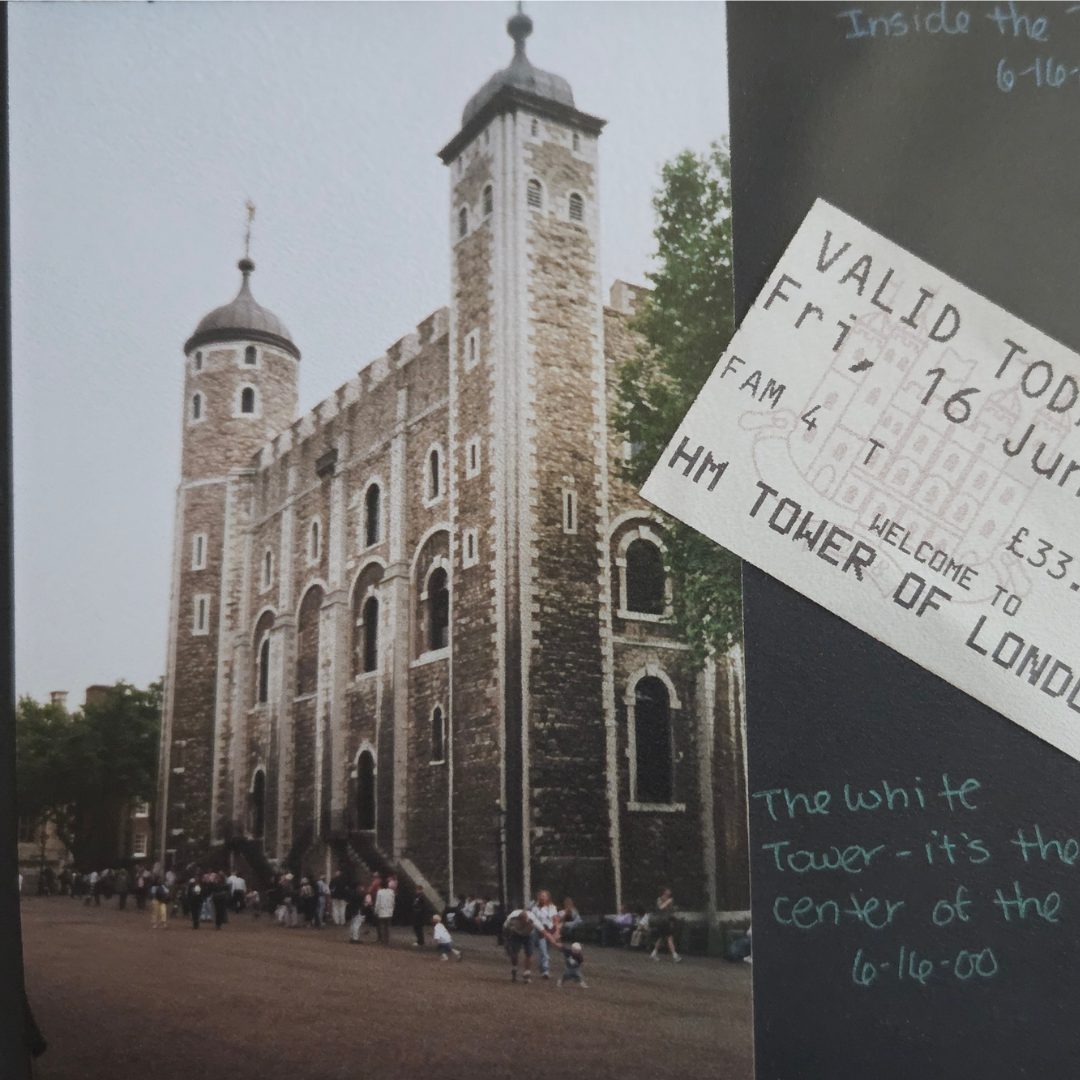
A picture from my first visit to the Tower of London in June 2000
If all of these details make your brain twinge as it attempts to summon long-forgotten facts you once memorized for a history exam, don’t worry! I promise you don’t need to know anything about the houses of York or Lancaster to enjoy this book. Harkin includes detailed family trees, but whether you think York and Lancaster are just towns in Pennsylvania, or whether “the Wars of the Roses” is a Jeopardy category you’d absolutely lose, you’ll be just fine.
Forget the long, expository paragraphs of textbooks. Instead, gossip between characters, proclamations from town criers, and grumblings from disbelieving townsfolk convey moments of great historical impact as everyday occurrences—because of course, they were just everyday occurrences to those who lived through them. The Pretender is largely a tale about people who made it into the written records as footnotes, if they made it at all. Characters in The Pretender talk about the monarchy’s machinations the same way my colleagues and I discuss current events at lunch. If you can keep up with today’s nonsensical news, you’ll have no trouble with the political intrigue and revenge plots of medieval England.
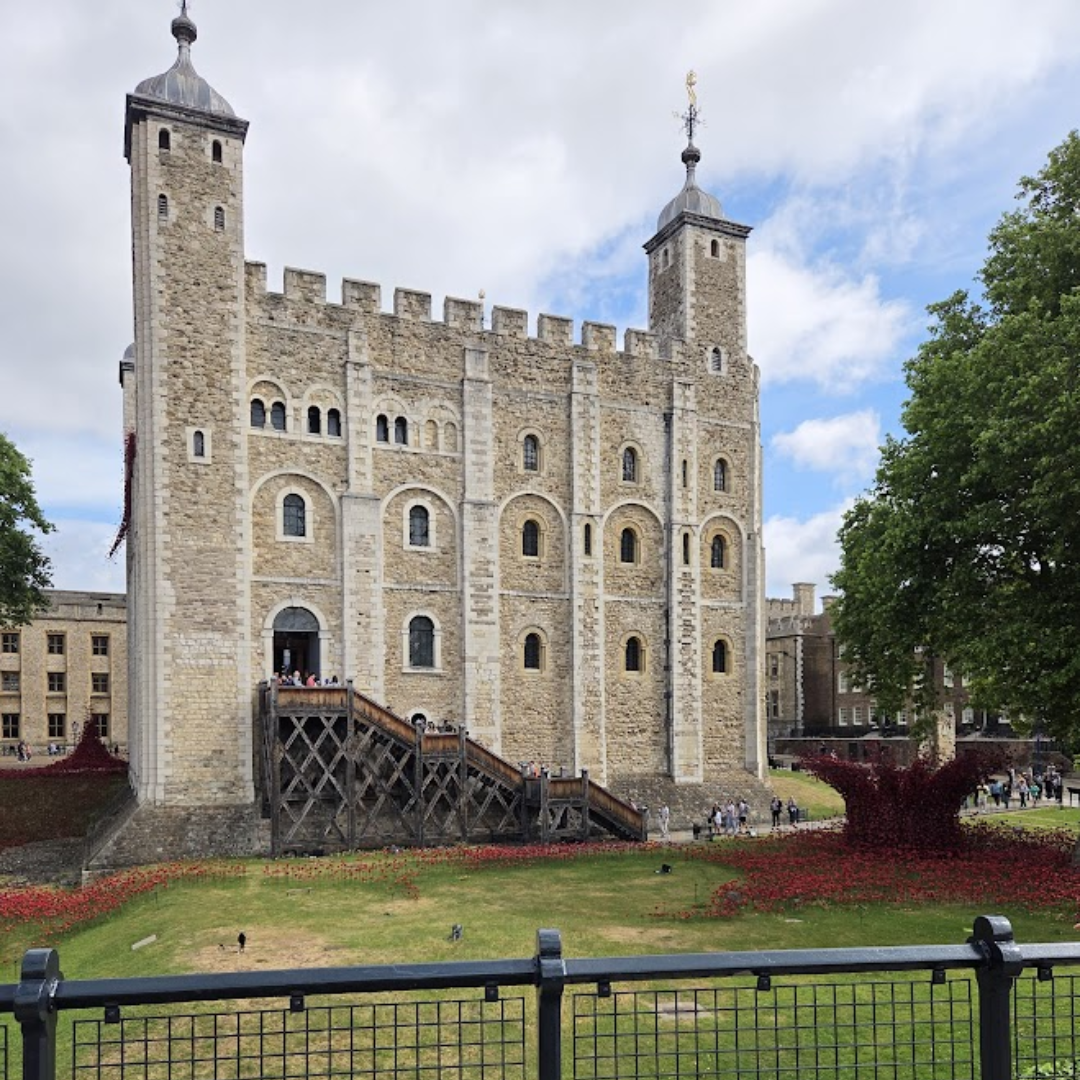
A picture from my second visit to Tower of London in June 2025
Reading is a motif throughout the novel. Punted across the realm from one conspirator to the next, John/Edward finds solace in his newfound access to literature. On the farm, he imagined recreating adventures he heard of (but never read) in books. Leaving the only father he’s ever known, he promises, “[W]hen I’m a man, you can come with me to Cathay—even further—and I’ll write my own book, The Travels of John Collan and Will Collan His Father.” At first, Edward is astounded by the libraries available to him, full of learned philosophies and histories. He reads them for advice on how to be a nobleman and dreams of writing his own book some day.
But in an account of Alexander the Great, he is shocked that the author “says it’s up to the readers to make their own judgment,” a thought as dangerous to Edward as heresy (147). When he complains about historians’ differing interpretations of the past, a courtier tells him, “But that squabbling and lying is history! And none of it worth a shit. Listen, all these historians, they’re all paid by kings. What do you think your King Richard’s historian wrote about Richard killing little princes? That’s right. Nothing! History’s corrupt. Like everything else” (167).
Disconcerting as it may be, the courtier’s declaration leads Edward to question his identity, God, and history itself. How can he begin to capture his life in words if he doesn’t know who he is? “What is he: a peasant, an earl, a bastard?” he worries. “No one to answer him—and he wouldn’t believe them if they did. He always wanted to write something true, but how can anything good flow from the quill of such an unknowable, untrue creature?” (349). History retells the doings of kings and heroes, those men blessed above all others by God. But neither literature nor God care about peasants and nobodies like him.
Counter to the historical and emotional weight of her subject, Harkin’s writing feels contemporary and fresh. F-bombs are as crucial to the occasional archaisms in building the book’s milieu. Her female characters in particular are irreverent, sarcastic, and hilarious. I was surprised how often I laughed while reading The Pretender. The book’s vibe is sort of Wolf Hall meets Everyone Knows Your Mother is a Witch, with a dash of Big Swiss energy once Edward comes of age and discovers what it means to “make ado.”
But no amount of “ado” can make up for the loss of his personal history. After growing up under numerous aliases, Edward decides he must wrest the plot away from the conspirators and shape it to his own ends. If he succeeds, he may find that writing offers “a way to live again” (467).
What a lovely wish, to find yourself on the page. May we all be so lucky. May we also have the courage to write ourselves into existence when the available literature doesn’t offer an honest mirror. May we write our own narratives, even when the outcome is uncertain. It’s like what Brandi is singing from my playlist right now: “I don’t need to see how it ends / to tell you that we’ll never be here again. / We’re only human.”
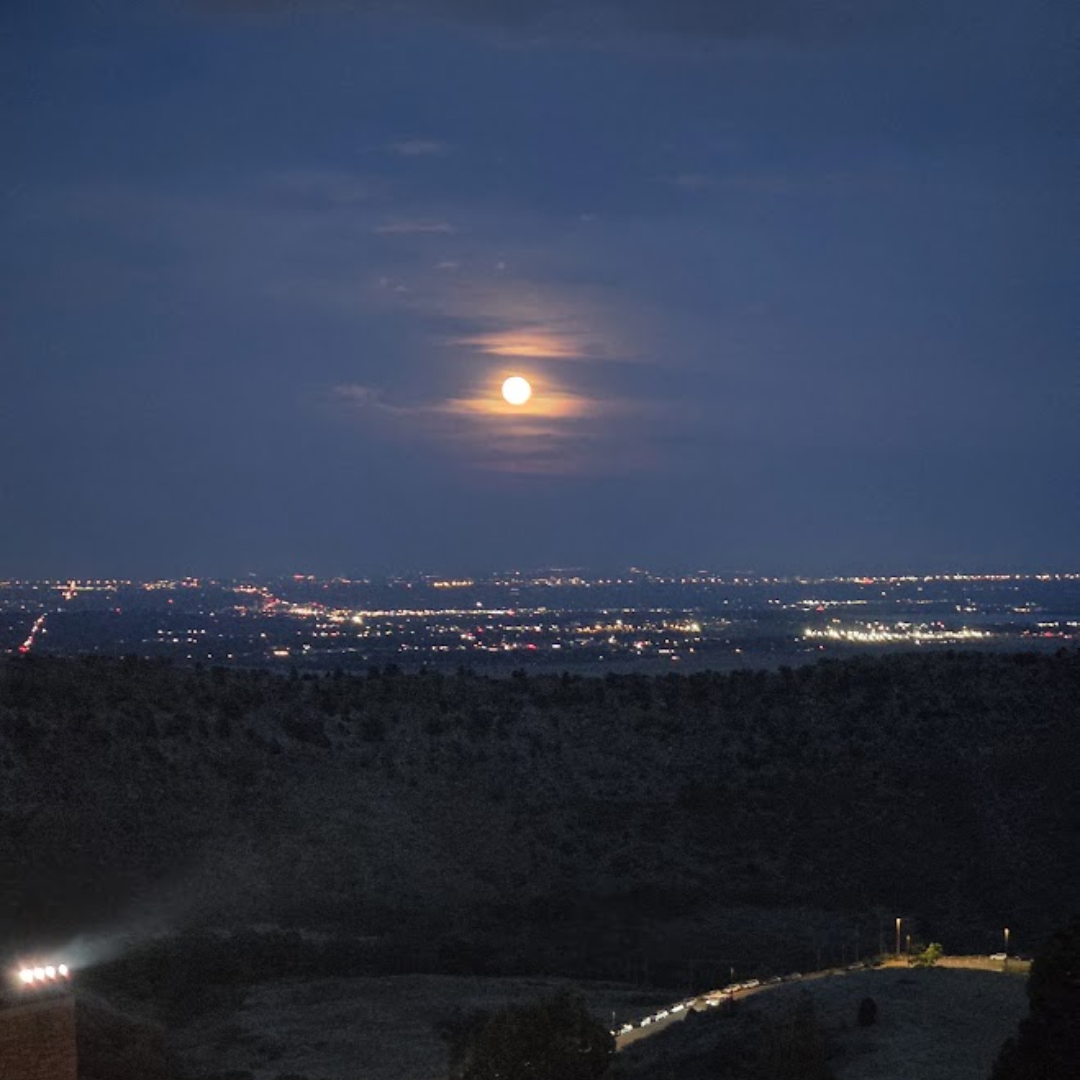
And for good measure, the moon over Red Rocks during a Brandi Carlile concert in September 2025
Need-to-Know
Pub Date: 2025
Length: 476 pages (every one is worth it!); audiobook runs 14.5 hours
Timeline: about a decade at the end of the 15th century
Setting: medieval England, Ireland, and Burgundy
Narrator: close third-person POV limited to John/Edward
Pairs Well With: Wolf Hall by Hilary Mantel; Everyone Knows Your Mother is a Witch by Rivka Galchen; Big Swiss by Jen Beagin
Book Club
Many years and miles from his upbringing on the farm, Edward reconsiders his anger toward Will Collan: “He used to be wroth at Will Collan for lying to him. Now he sees that his dad-that-was didn’t have much choice. Some nobles, emissaries from the fairy kingdom, came to his farm and told him what to do. He was a peasant. How could he say no?” (271) What is your opinion of Will Collan? How would you respond to the sentiment Edward expresses here? To what extent should Will be let off the hook for abandoning his son?
For much of the book, Edward longs to get his hands on a copy of Morte d’Arthur. When he finally does, he’s shocked by the content. Instead of the “Christian adventurings” he expected, the book is full of characters “having ado,” which “seems to be a favorite preoccupation of the knights and ladies, no matter whether they’re virgin, married, or neither” (193). Later, a courtier tells him that the book is a legend, not a history, and that “this Arthur stuff is vittles for peasants and babies, not learned men” (222). How does Edward’s experience of Arthur compare to his expectations? What similar experience have you had in your life? This could be with a book, an event, or even a person.
Close Reading
Shortly before being taken from the village to Oxford, John attends a morality in a nearby town with Will Collan, his (presumed) father, and Jennott, his household’s dairymaid. He rides back to the village in the back of a cart:
“When the day is over, several people come back with them; squeezed woolen bodies and yeasty breath in the newly cold blue-purple air. Only the irregular jounces of the cart keep John’s eyes open; his eyelids carry an impossible weight. The voices around him break into pieces between the noise of the wheels—
can’t say that, he’s the king now, they crowned him in London
thunk
killed the queen’s kin, all them woodvilles
thunk
both the little princes in the tower
thunk
probably dead
thunk
the queen must be right doleful, imagine
thunk
the poor cow
—John closing his eyes at last, his head on Jennott’s shoulder, the sounds of the human world calling after him as he heads into the land of dream: reaching, falling short” (18-9).
Part of the magic in The Pretender comes from the immediacy of the prose. Through her characters’ gossip, Harkin makes a complicated, long-ago history feel like it’s happening right now. This technique appears throughout the novel, but this specific section is noteworthy for its structure as well.
The lines between the dashes have the appearance of a contemporary, free verse poem. While the rest of the novel generally uses correct capitalization, these lines are lower-case because they are merely snippets John half-hears while he’s trying to sleep. Alternating the gossipy lines about royalty with the repeated word “thunk” not only provides a humorous element but also keeps the setting—the back of a crowded wooden cart driving along unpaved dirt roads—front of mind.
Additionally, the final three words after the colon foreshadow future events. Throughout the novel, John-as-Edward is shuffled from one location to the next, subject to the whims of nobles who view power as a game and Edward as a pawn. Plots fall apart for various reasons, “falling short” just as John’s attempt to dream fails here. The final line of the novel also echoes this scene. After finally establishing a home, Edward leaves once more: “But riding on, still, hoping to come to a place where he can live again” (476).
The “hoping” of the ending scene draws a parallel to the “reaching” of the earlier cart scene, but whereas “reaching” is paired with the ominous “falling short,” “hoping” is paired with the idea of “liv[ing] again.” That contrast leaves Edward in an encouraging, if incomplete and imperfect, tone.
Creative Writing
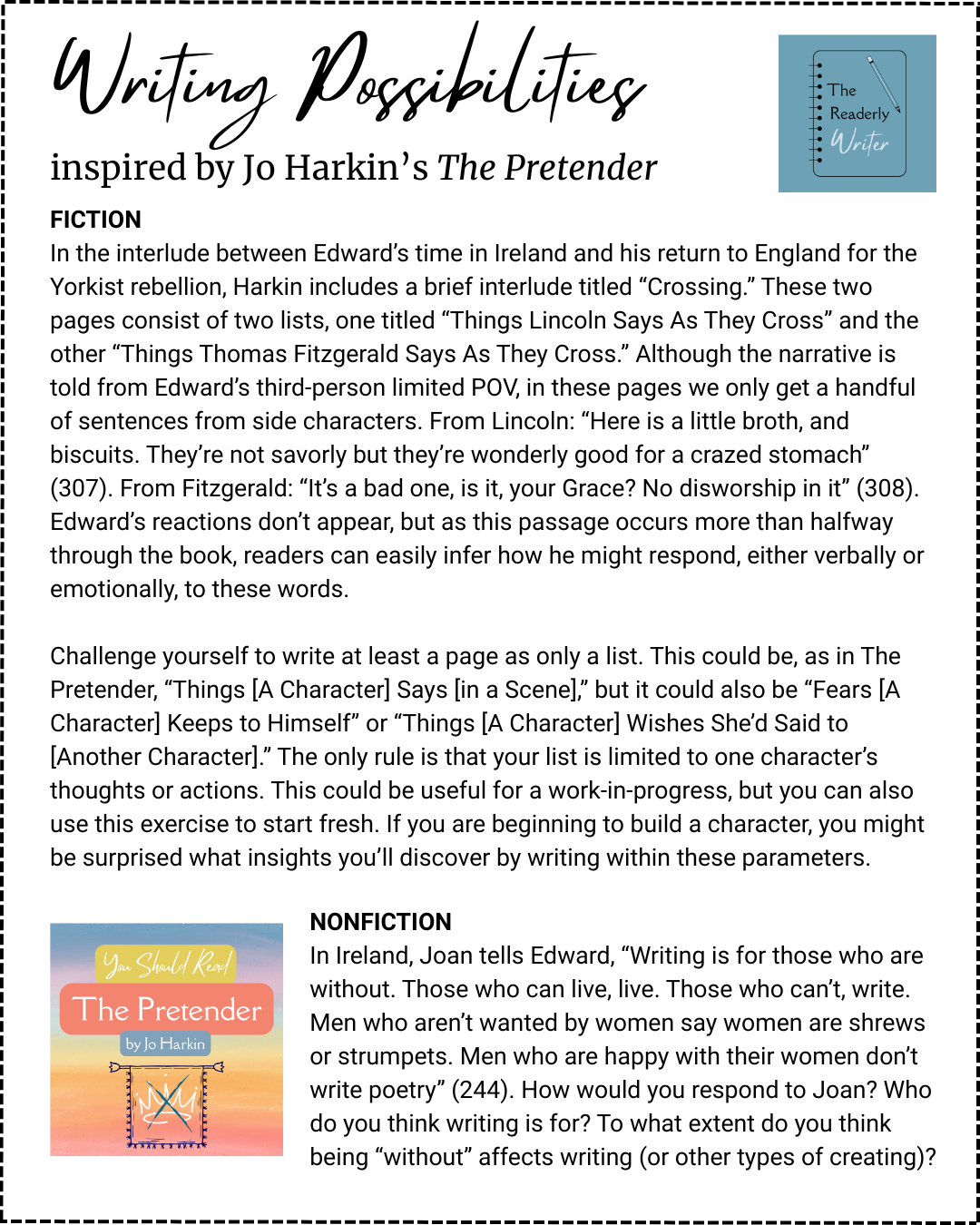
Sentence Study
After his time in Oxford, Edward crosses the sea to stay with Margaret of Burgundy, his supposed aunt, in Mechelen:
“The jellied quality of Edward’s early days at Mechelen warms, melts away.”
I love the adjective “jellied” here because it’s doing so much work. “Jellied” is full of historical significance. According to this fascinating blog about medieval food, “it is generally observed by food historians that medieval jelly—gelatine—was used as a means of preserving meat and fish, an alternative to salting.” The term refers to an actual culinary practice that would have been used during Edward’s time. But it also has a wonderful visual quality to it. For modern readers, “jellied” conjures images of PB&J sandwiches or perhaps (hello, millennials!) Jell-O jigglers. We can picture the wobbliness of contemporary fruit jelly and imagine the way it liquifies and slides off a warm piece of toast, just as Edward’s sense of being suspended “melts away” as he becomes familiar with Mechelen.
At first glance, the word “warms” seems superfluous because melting requires warmth. But “warms” is doing double duty here, much like “jellied.” Just before this sentence, Edward shares a moment of happiness with Philip, the only other child in the great house. They giggle and bond over tossing stones at windows. Edward’s heart begins to loosen, just as jelly melts when it becomes too warm. If Harkin had only included “melts away,” we would have understood the visual imagery, but the emotional connection wouldn’t be as strong. Layering “warms” and “melts” together, though, indicates the depth of Edward’s change here.